

How accurate are AI calorie counter apps? An honest look
AI calorie counters do well on single, visible foods and get weaker on mixed plates and hidden ingredients. Used as an editable first draft, they still beat the guessing most of us do without a tracker.
How accurate are AI calorie counter apps, really?
Every photo-based calorie counter does two separate jobs: it names the food, and it estimates how much of it there is. The first job has become reliable for common, clearly visible foods. The second is harder, and it is where most of the error in a photo estimate comes from. Add what a camera can't see at all (oil in the pan, butter in the sauce, sugar in the dressing) and you have the full picture of where AI calorie counting drifts.
That gives a consistent ranking. Simple, separated foods sit at the accurate end. Complex or layered dishes sit at the messy end.
| What you scan | How well it usually goes | The weak point |
|---|---|---|
| Single whole food (apple, banana, slice of pizza) | Strong: easy to name, easy to size | Unusual portion sizes |
| Packaged food via barcode | Strongest: uses the product's label data | How many servings you actually ate |
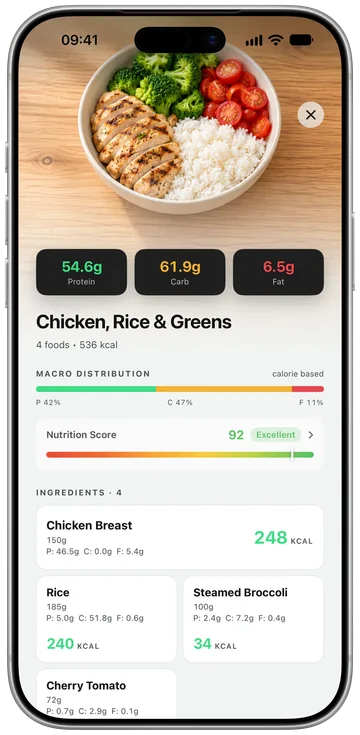
| Simple plate with two or three separated foods | Good: each food is visible on its own | Cooking method (fried or grilled) |
| Mixed or layered dishes (curry, burrito, casserole) | Weakest: much of the food is hidden | Hidden ingredients, depth of the dish |
| Oils, dressings, sauces | Often missed entirely | Invisible in a photo |
Where AI calorie counting actually fails
Three failure modes cause most of the error, and knowing them is half the fix.
- Invisible calories. A tablespoon of olive oil is about 120 calories and leaves almost no visual trace. Dressings, butter used in cooking and sugar stirred into sauces can't be seen by any camera-based system. This is the main reason restaurant meals get underestimated.
- Portions without a size reference. A photo flattens depth. A mound of rice could be a small or a large serving, and nothing in the picture says which.
- Look-alike foods. Whole and skim milk look identical. So do regular and diet soda, or fried and baked chicken. The AI has to guess, and it sometimes picks the lower-calorie twin.
These limits apply to every photo-based tool, including general chatbots. We cover that comparison in asking a chatbot for calories from a photo. Dedicated apps have one structural advantage: they are built for you to correct the result in a couple of taps, which a chat makes tedious.
Is an estimate good enough to lose weight?
For most people, yes, and this is the part accuracy debates usually miss. Say you aim for a daily deficit and your app misjudges lunch by a hundred calories. You are still in a deficit. Errors also partly cancel out over a week: some meals get overestimated, some underestimated, and the trend stays usable.
What actually derails progress is rarely one imperfect lunch. It is the meals that never get logged at all, and the slow drift of untracked snacks and oils. Your weight trend is the final feedback loop anyway: if it doesn't match your logged intake after a few weeks, adjust your targets.
The takeaway: a calorie number that is a little off but logged every day beats a perfect number you only track for one week. With AI calorie counters, consistency does the heavy lifting.
How Foodify handles the hard cases
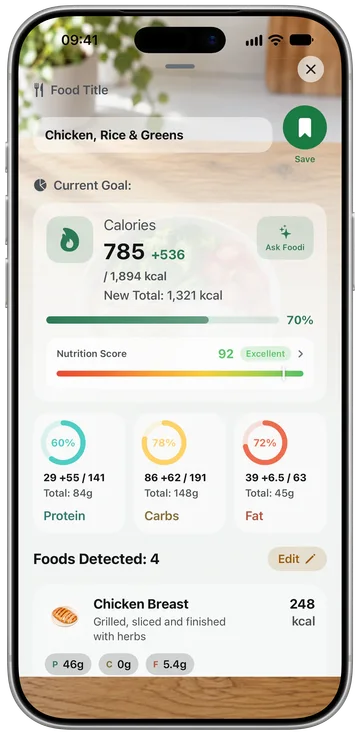
Foodify is built on the assumption that no photo estimate should be final. Every scan produces an editable result: you see the foods, portions, calories and macros before anything is saved, so a missed dressing or an oversized rice estimate is a five-second fix rather than a silent error in your log.
For crowded plates, Foodify lists each food separately with its own portion estimate, which is exactly where single-guess tools struggle most. For packaged foods, the barcode scanner skips estimation and pulls the nutrition facts from the Open Food Facts database. For the full walkthrough of photo logging, see our guide to counting calories from a picture, or read what to compare when choosing an AI calorie counter.
Foodify is free to download on iPhone, and Foodify Pro is required to use the app. The yearly plan starts with a 3-day free trial.
How to get the most accurate scans
- Shoot from about 45 degrees, with the whole plate in frame and decent light. Straight-down shots hide depth; extreme side angles hide foods behind each other.
- Keep a size reference in frame. A fork, your hand or a standard dinner plate gives a sense of scale.
- Separate foods when you can. Three visible foods beat one indistinct pile.
- Add what the camera can't see. Cooked in oil? Dressing on the salad? Edit the result before saving. This is where most of the remaining error lives.
- Use the barcode for anything packaged. Label data beats a visual estimate.
- Spot-check your regulars once. Weigh or check the label on two or three meals you eat often. You'll quickly learn where your estimates run high or low, which helps most with restaurant meals, where hidden oils do the most damage.
The comparison that matters: AI vs. guessing
Critics of AI calorie counting usually compare apps against a food scale. But for most people the realistic alternative is no tracking at all, and human self-reporting has well-documented blind spots. A 2020 review of dietary assessment methods describes systematic under-reporting of energy intake across adult and child studies (Ravelli and Schoeller, Frontiers in Nutrition). A well-known 1992 study in the New England Journal of Medicine found that a small group of people who described themselves as unable to lose weight reported eating 47% less than they actually ate (Lichtman and colleagues).
Against that baseline, an editable estimate you check at every meal is not a downgrade. It is a practical upgrade over the default human setting, for very little effort.
FAQ
Can AI calorie counters detect cooking oil and dressings?
Not reliably. Oil absorbed into food and dressing mixed into a salad leave little or no visual signal, so photo-based systems often miss them. The fix is editing the result: add a tablespoon of oil or dressing before saving. When editing is quick, as it is in Foodify, this becomes a habit rather than a flaw.
Is scanning food more accurate than typing it in manually?
Per entry, careful manual logging with a food scale is more precise. In practice, many people stop weighing and searching after a few weeks, and a meal that never gets logged counts as zero. Photo scanning trades a little precision per meal for much better consistency, which is what decides results over months.
How accurate is portion size estimation from a photo?
It is the weakest link, especially for shapeless foods like rice, pasta or mashed potatoes. Including a size reference in the photo and adjusting the portion when an estimate looks off closes most of that gap.
Do AI calorie counters get more accurate over time?
Recognition models keep improving, but your own accuracy improves faster than the technology. After a week or two you know which of your regular meals scan cleanly and which need a quick edit, and once you save a corrected meal, your most frequent foods log the same way every time.